The music
Pinpeat: the music of Khmer dance
The pinpeat orchestra and the female chorus behind Khmer classical dance: what the ensemble is, how its pieces cue the dancers and what to listen for.
Book an Apsara evening ↗Quick answer
Khmer classical dance is accompanied by an orchestra, the pinpeat, and a female chorus that comments on the plot. The pinpeat is the largest Khmer traditional ensemble, mainly wind and percussion, and it plays set pieces for entrances, exits, flying and walking. Listen to how each piece cues the dancers.
Two sources of sound
UNESCO describes two musical forces behind the dance. An orchestra accompanies it, and a female chorus provides a running commentary on the plot. The chorus also highlights the emotions that the dancers mime. Because dancers do not sing or generally speak, the music and the chorus carry what words would carry in other theatre. When you watch a Khmer classical dance, you are watching a stage picture that the music is steering.
What the pinpeat is
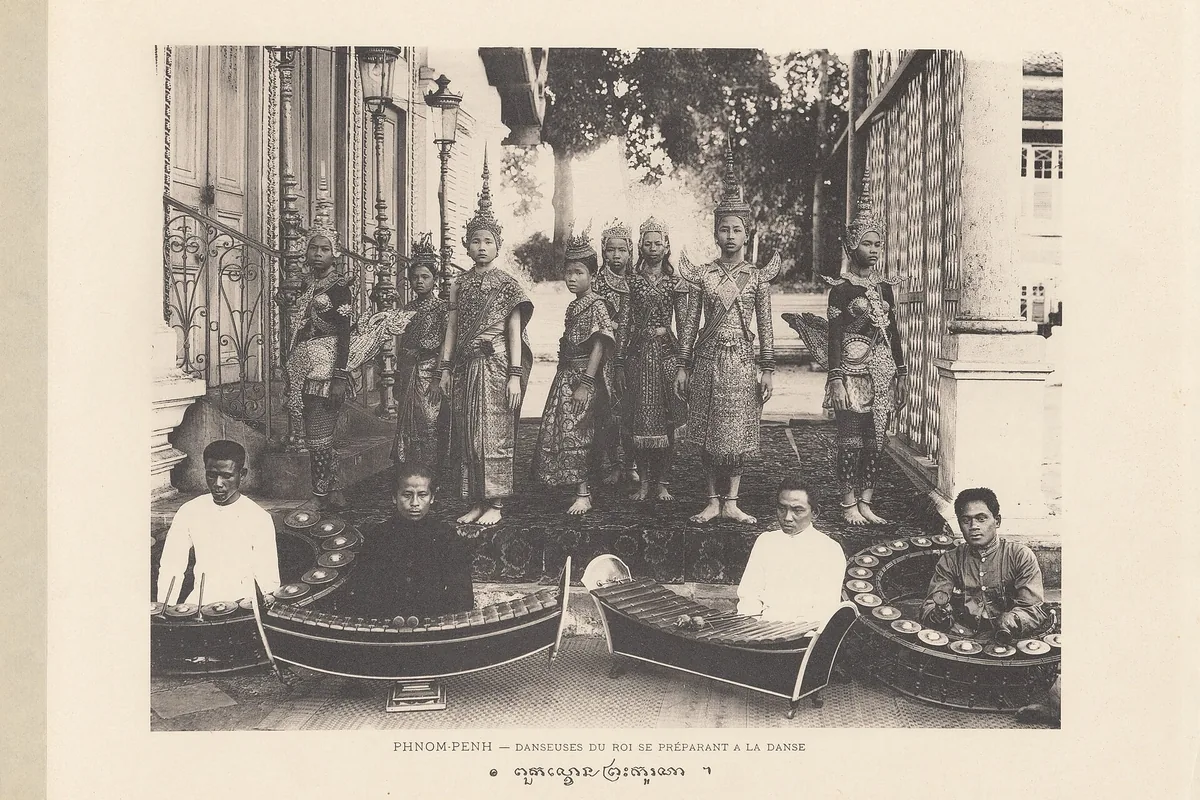
The pinpeat is the largest Khmer traditional musical ensemble. It has performed the ceremonial music of the royal courts and temples of Cambodia since ancient times. The orchestra consists of approximately nine or ten instruments, mainly wind and percussion, including several varieties of xylophone and drums. It accompanies court dances, masked plays, shadow plays and religious ceremonies, so the sound is tied to ceremony as much as to entertainment.
Relatives in Laos and Thailand
The pinpeat is analogous to the pinphat, which the Lao people adopted from the Khmer court, and to the piphat ensemble of Thailand. Wikipedia says the pinpeat in fact originated in Cambodia. The name comes from two Sanskrit terms: pin, the harp that was formerly the premier instrument of the ensemble, and peat, an ensemble of instruments. So the name itself recalls the harp that is no longer the lead voice of the ensemble.
A very old sound
Wikipedia says the ensemble originated in Cambodia before the Angkorian era. The pin, a harp, was its lead instrument in early times and appears frequently in the art on Khmer temple walls. The harp later dropped out of the pinpeat, and Wikipedia reports that it has since been revived by a French ethnomusicologist and a Cambodian musical craftsman and professor. Today the pinpeat uses kong gong chimes as lead instruments, a practice that dates back to the Angkorian period. Wikipedia also notes that images of the ensemble have been found on the walls of Angkor.
A piece for every moment
Khmer classical dance uses particular pieces of music for particular events, such as when a dancer enters or leaves a scene, or performs actions such as flying or walking. The pieces are arranged to form a suite, and new pieces are rarely created. Sathukar, a song of blessing, is often used to begin a performance. Smaeu introduces a character or a group of dancers, and Lea marks a character's departure from the scene. Krao nai is the overture of the giants as they go into combat. Because the pieces are tied to events, a listener can learn to hear what is about to happen on stage.
Soft melodies and driving percussion
Wikipedia's list of pieces shows how the music shapes the mood. Sinuon is a soft and slow feminine melody. Cheut chhing is characterised by the constant percussion of drums and small cup-shaped cymbals, and it is used to present an action such as setting out or flying. Klom shows the grace and beauty of a character wielding a weapon. Phya deun accompanies dancers marching, for example at the start of the welcome dance Robam Tep Monorom.
How to listen on the night
Listen for the pattern rather than for a tune. Each entrance and exit has its own piece, the percussion drives the action, and the slower melodies sit under the graceful passages. If a chorus is present, it gives a commentary on the plot while the dancers mime it. Check the booking page for what the evening includes, and treat this guide as a description of the tradition rather than a promise about any one night's line-up.
Frequently asked questions
What is the pinpeat?
The largest Khmer traditional musical ensemble, of approximately nine or ten instruments, mainly wind and percussion, including several varieties of xylophone and drums.
What does the chorus do?
According to UNESCO, a female chorus comments on the plot as it unfolds and brings out the emotions the dancers mime.
Does Khmer dance have its own music for each moment?
Yes. Particular pieces mark events such as a dancer's entrance or exit, or flying and walking, and they are arranged into a suite.
Do the dancers sing?
No. Dancers do not sing or generally speak.
Sources