The costume
Apsara costume and headdress
How an apsara dancer is dressed, from the pleated sampot and silk bodice to the three-pointed crown, collar and jewellery, and how the costume copies Angkor.
Book an Apsara evening ↗Quick answer
An apsara dancer wears a pleated silk sampot, a skin-coloured silk bodice, a gold-coloured collar, jewellery on both arms and a tall crown, all modelled on the devatas carved at Angkor Wat. The lead usually wears white, and her crown has three points with two rows of spherical decorations.
A costume copied from stone
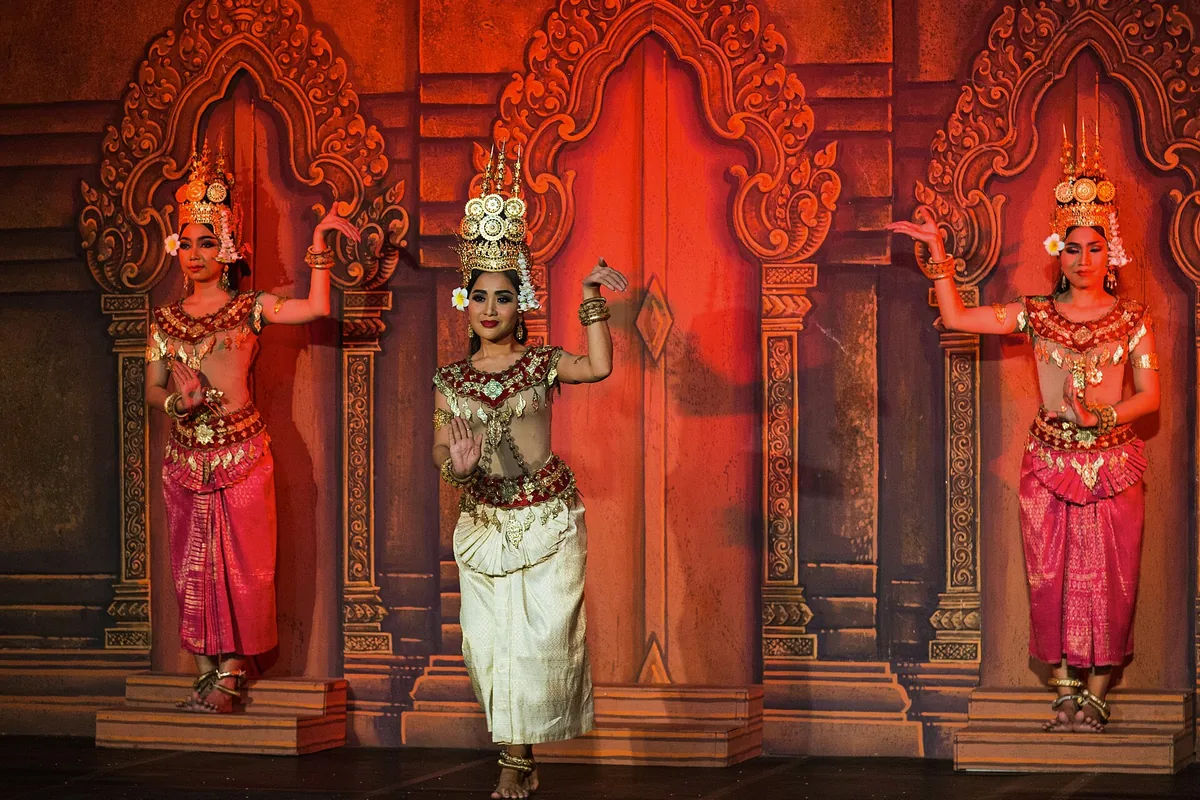
The costume of the apsara role is based on the devatas depicted in the bas-reliefs of Angkor Wat. That is why it looks different from other Khmer dance costumes, even though the dance itself shares much with them. Wikipedia describes the garments as silk brocade and fine metalwork, and it ties each piece to something carved in the temple. Seeing the costume next to the carvings is the quickest way to understand how the dance borrows from the stone. Wikipedia adds that most Khmer ballet costumes are thought to represent what divinities wear.
The skirt-cloth
The apsara wears a sampot sarabap, a type of silk brocade skirt-cloth. It is worn samloy-style, also called samloy robab, and is intricately pleated in the front like the Angkorean devata. The lead's sampot is generally white, while supporting dancers appear in sampots of green, blue or red. In the photograph above, the lead in white and the two dancers in magenta show the same arrangement. The pleated cloth is folded and secured with a belt, often gold, called a khim khat, and the draped pleats fan over the belt.
Bodice and collar
On top, a silk bodice is worn, generally skin-coloured, to suggest nudity. Just below the neck sits a round decorative collar, called the srang kar or samrong kar, embellished with detailed gold-coloured copper ornaments and beaded designs. It is usually decorated in two separate rows, with additional copper ornaments hanging below them. A belt, the kravat khim khat, resembles the collar.
The crown
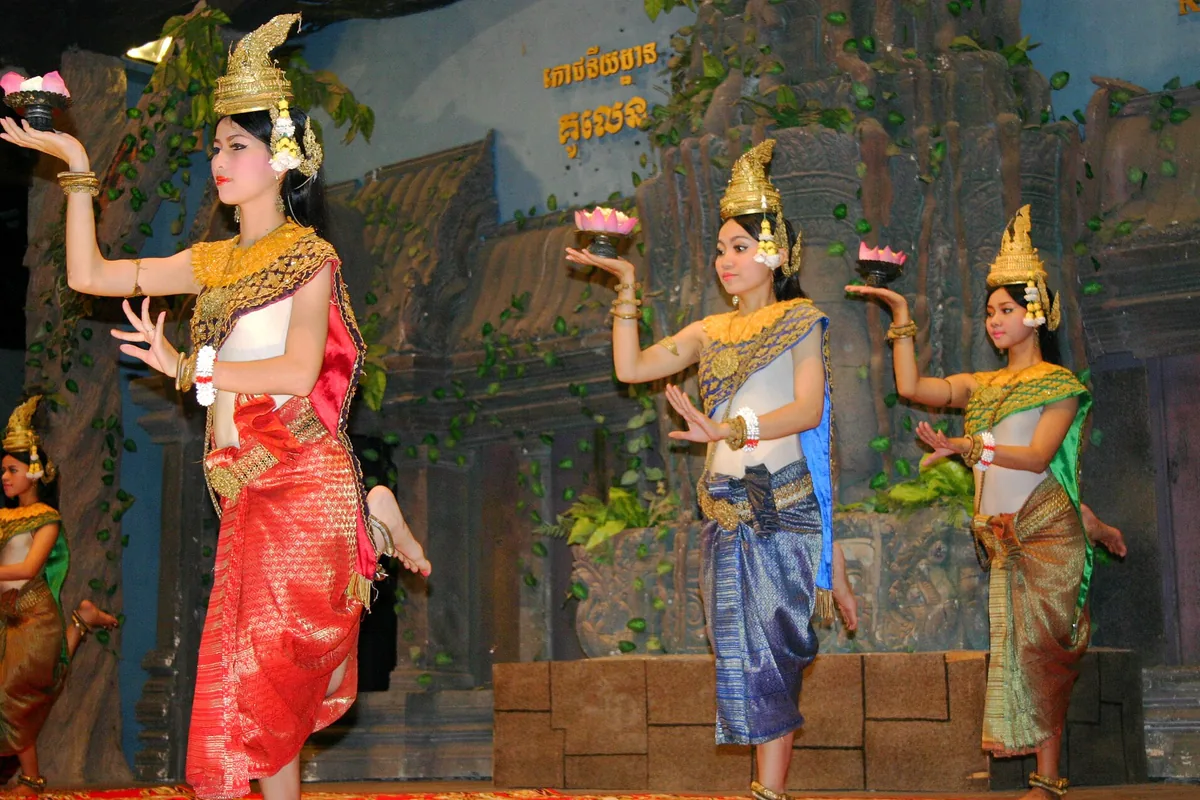
The headdress of the lead apsara has three points, or tips, with two rows of spherical decorations, like the apsara pictured at Angkor. The headdress worn by subordinate dancers commonly has three points and only one row of spherical decorations. A flower tassel is worn on the left side of the crown and a champei flower on the right side of the head, and champeis are sometimes worn in a cascade in the hair.
The jewellery
Wikipedia lists four types of wrist jewellery: the kong rak, a diamond-like studded bracelet; the patrum, a spring-like coiled gold-coloured copper; the kong ngor, bracelets of small beaded spheres; and the sanlek, a rounded jewel. The apsara wears an armlet on both arms. Gold ankle jewellery is usually worn, and the sangvar is a loosely decorated band of beads worn crosswise. A golden flower made of thin flexible copper may be worn at the waist or carried in the dance.
Sewn into the costume
Dressing a Khmer classical dancer means sewing the garments onto her, a process that lasts multiple hours. Dancers traditionally wear fragrant flowers that are prepared during the day and then removed from water and attached for a performance, although fresh flowers are sometimes replaced by faux ones. All of this happens before the Teacher Salute Ceremony that precedes the troupe's entrance, so by the time you see the dancers, the costume has been built around them.
What sets the apsara apart
Most female characters in Khmer classical dance wear a single armlet on the right arm, like the carved women of Angkor, while an apsara wears the armlet on both arms. Apsara dancers also wear a diamond-like bracelet, the koang rak, and dangling earrings modelled on flowers. These small differences, together with the three-pointed crown, are what mark the apsara among the other female roles. For a viewer, the quickest tells are the crown and the white skirt-cloth of the lead.
Frequently asked questions
What is a sampot?
A skirt-cloth. The apsara wears a sampot sarabap, a silk brocade type that is pleated in the front like the Angkorean devata.
What colour does the lead apsara wear?
The lead's sampot is generally white. Supporting dancers appear in green, blue or red.
How many points does the lead crown have?
Three points, with two rows of spherical decorations. Subordinate dancers commonly wear three points and one row.
How is the costume put on?
The garments are sewn onto the dancer, a process that takes multiple hours.
Sources